

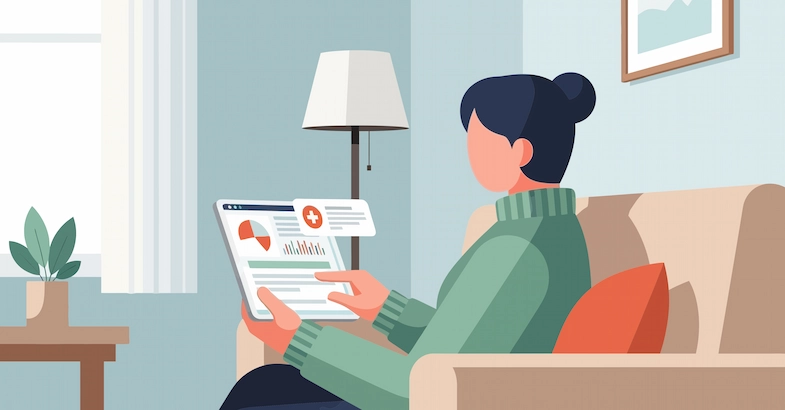
Sometimes a seemingly insignificant detail can spark a realisation. The idea for this study germinated from one such moment. “I want to book a gynaecology appointment through that app, but my brother monitors my phone activity,” said Prernai worried about her privacy. Hailing from a family with a modern outlook and educated in a metropolitan city, Prerna didn’t fit our idea of the woman whose access to media is borrowed. Yet here it was, the digital gender divide we thought the likes of us were far removed from, facing us from across a coffee table.
Media exposure has a direct impact on health awareness and, in turn, health-seeking behaviours.1,2. Studies link higher mass media exposure to better healthcare utilization among women.2 Another study conducted in Nigeria, shows that as women’s exposure to media increases, their awareness about maternal health increases substantially.3 This finding is relevant for the developing world, where insufficient healthcare before, during, and after childbirth continues to contribute to high maternal mortality ratio (MMR). MMR is defined as the number of maternal deaths per 1 lakh live births. In India, MMR stands at 88 deaths per 1,00,000 live births4 against the SDG 3.1 target of 70. However, despite ongoing efforts, access to media remains uneven. The National Family Health Survey (NFHS-5, 2019-21) data reveals that 41 percent of women aged 15-49 years do not access any form of media, including newspapers, TV, radio and cinema, at least once a week. Interestingly, the figure has increased by 16 percent since 2015-16. Only 33 percent of women have ever used the internet, with the numbers being even lower for rural women.1
Aligned with the UN Sustainable Development Goals, the Indian government has made concerted efforts to ensure health and well-being for all. India’s flagship health programs, such as Ayushman Bharat, National Health Mission, and women-focused schemes like Janani Suraksha Yojana and Pradhan Mantri Matru Vandana Yojana, rely on mass media to raise awareness about maternal care, nutrition, cancer prevention, immunization, and other health services. However, studies highlight the need to strengthen health literacy and mass media exposure among the vulnerable sections of the society, including women. Mass media exposure results in lesser perceived lack of barriers to health access in women.5 They are often referred to as magic multipliers–amplifying knowledge, changing behaviour and setting wider transformation in motion. However, media’s multiplier effect is as strong as public’s ability to access these messages. Open access to media is, thus, crucial but Prerna’s experience was a reminder that when we view media access through singular lenses–of geography, social status or education–we miss the full picture.
Women’s access to media doesn’t trace a linear path and their media access gaps are not shaped by one factor alone. For instance, when we consider a single factor such as location, rural areas appear to experience higher inequality. Only 25% of rural women have ever used the internet, compared to 52% of women in urban areas.1 However, this one-dimensional view does not provide a complete picture. Women in rural settings may, in some cases, have better media access due to other intersecting social determinants, such as class, caste networks, or education, than what their geographical location alone suggests. Conversely, urban areas are not uniformly advantaged; individuals in cities may still face significant socio-economic barriers, just like in Prerna’s case. Inequality is rarely an outcome of a single factor; it often results from an overlap of many. This highlights the importance of examining inequalities through an intersectional lens.
In our study, we use the intersectionality approach to examine how various socio-demographic and economic factors converge to influence women’s media access and, by extension, their health awareness and utilisation. The goal is to capture the cumulative impact of these barriers on media and health access, moving beyond isolated perspectives to present a comprehensive understanding of the issue.
When socio-economic and gendered barriers intersect, they tend to leave women vulnerable, less informed and standing at the farthest end of the queue for last-mile healthcare delivery. It’s a stark paradox because the healthcare systems that intended to embrace the most vulnerable first, inadvertently, end up alienating them. The path forward lies in reimagining how we design, carry and deliver health communication to women where they are–at the crossroads of multiple disadvantages. Through the lens of intersectionality, media can reach the most vulnerable among the vulnerable. And when that happens, mass media become not just true multipliers, but also equalizers in healthcare. Equal media sparks equal knowledge and equal knowledge can unlock equal health outcomes. The real question is not about identifying the barriers but: how boldly must we dismantle them so that our messages are heard beyond?
References:
- International Institute for Population Sciences (IIPS) and ICF. 2021.
National Family Health Survey (NFHS-5), 2019-21.
- Dhawan, D., Pinnamaneni, R., Bekalu, M., & Viswanath, K. (2020). Association between different types of mass media and antenatal care visits in India: a cross-sectional study from the National Family Health Survey (2015–2016). BMJ Open, 10(12), e042839. https://doi.org/10.1136/bmjopen-2020-042839
- Igbinoba, A. O., Soola, E. O., Omojola, O., Odukoya, J., Adekeye, O., & Salau, O. P. (2020). Women’s mass media exposure and maternal health awareness in Ota, Nigeria. Cogent Social Sciences, 6(1). https://doi.org/10.1080/23311886.2020.1766260
- Sample Registration Syatem (SRS)-Special Bulleting on Maternal Mortality in India 2021-23.SRS_MMR_Bulletin_2021_2023.
- Pradhan, M. R., & De, P. (2025). Women’s healthcare access: assessing the household, logistic and facility-level barriers in India. BMC health services research, 25(1), 323. https://doi.org/10.1186/s12913-025-12463-9

Authors’ Bios’:
Abhiyan Chaudhari
Research Analyst
Abhiyan Chaudhari is a Research Analyst at the Max Institute of Healthcare Management, Indian School of Business. He holds an MSc from the International Institute for Population Sciences, Mumbai, and has previously worked as an M&E Associate at Prakruthi Trust. He also completed an internship at the Peace Research Institute Oslo.

Navsangeet Saini
Writer
Navsangeet Saini is a communication professional with over 13 years of experience across academia, media and communication research, and writing. She holds a Ph.D. in Mass Communication with ongoing research interests in gendered media narratives, media democracy, and media ecology, exploring how storytelling shapes communities and societies. At the Max Institute of Healthcare Management, Indian School of Business (MIHM-ISB), she applies these perspectives to healthcare communication, crafting narratives that make complex research accessible and relevant to diverse audiences.

Dr Chaitra Khole
Associate Director
Dr Chaitra Khole is working as the Associate Director at the Max Institute of Healthcare Management at the Indian School of Business. She is a public health researcher with a focus on geriatric health, nutrition, health systems strengthening, and healthcare management. She holds a Ph.D. in Health System Management from the Tata Institute of Social Sciences (TISS), Mumbai. Prior to joining ISB, she served as an Assistant Professor in the Health Care Management Department at Prin. L.N. Welingkar Institute of Management Development and Research, Mumbai.