
On Moturiki, a small island off Fiji’s mainland, reaching a child for vaccination can involve a boat ride, a walk up a hill and a long trek between villages. Nine villages are served by a single nurse, who carries vaccines with her through terrain and weather that can make even a routine vaccination visit an undertaking.
Moturiki offers a glimpse of a challenge that is easy to overlook: getting vaccines to a health facility is only part of the journey. In remote communities, the final stretch can determine whether a child gets vaccinated at all.
This was one of the questions I set out to understand during my recent visit to Fiji. At the Max Institute of Healthcare Management at Indian School of Business, we are beginning an impact evaluation of Emvólio, a portable vaccine carrier developed by Blackfrog Technologies. The study will examine whether it can support vaccination outreach in remote communities and what effect this has on the wider programme.
The challenge is particularly relevant in Fiji, an archipelago of more than 300 islands, around 110 of them permanently inhabited. Many communities are accessible only by boat, while cyclones and other severe weather events can further disrupt access.
Emvólio is designed to maintain vaccines between 2°C and 8°C, with extended cold-life for field outreach. It also records temperature and location data and can be supported by a portable solar panel, which can be useful where electricity is unreliable.
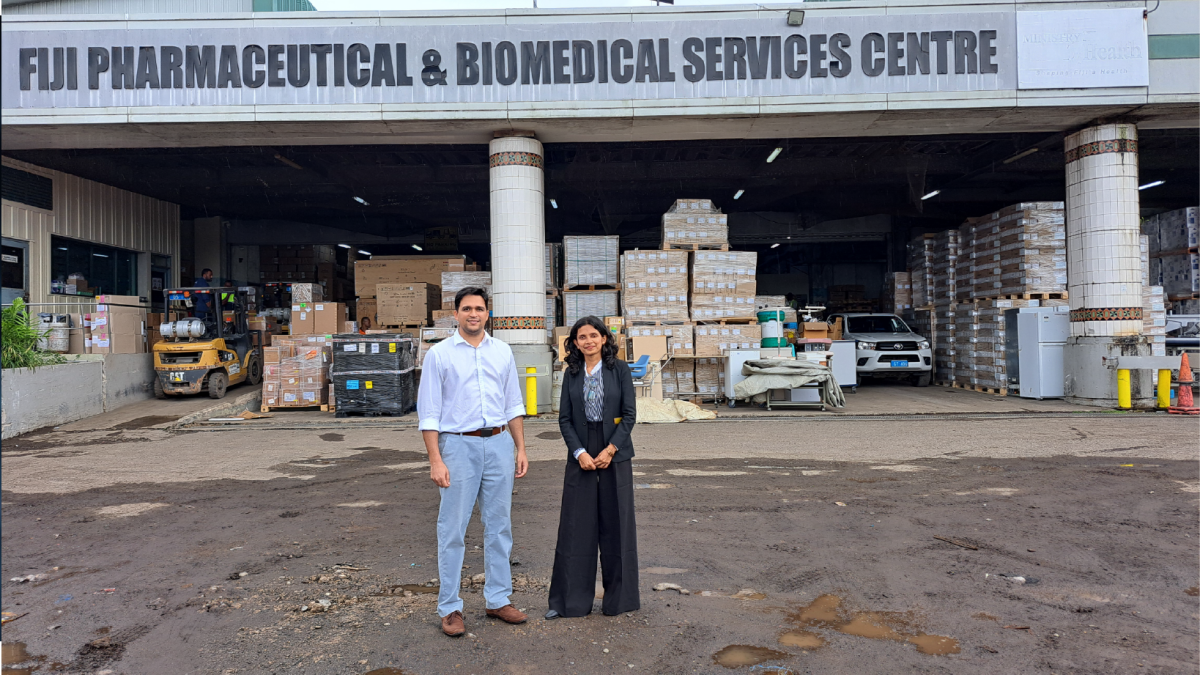
Fiji is preparing to deploy 64 Emvólio devices and solar panels. During my visit, I joined a training session with nurses who will use the devices and visited a sub-divisional hospital in Naitasiri and the Government Pharmacy, which houses the national vaccine warehouse. These visits offered a view of the system behind a vaccination session, from storage and stock management to transportation and frontline outreach.
The evaluation will examine the devices’ effect on vaccination coverage, vaccine availability, wastage, routine workflows and the costs of outreach. We will combine programme data with temperature and location data from the devices, alongside surveys and interviews with health workers.
The larger question is whether strengthening cold-chain capacity can make vaccination more accessible in communities where geography makes the last mile particularly difficult.
As the deployment gets underway, we look forward to learning from Fiji and exploring what these lessons might mean for other remote settings across the Pacific and beyond.
My thanks to Sister Litiana Volavola, National Program Manager for Immunisation, and Dr Rachel Devi, Head of Family Health, for their support during the visit and for helping me understand the realities of vaccination delivery in Fiji.
About Rohan
Rohan Bapat is an FPM student in Operations Management at the Indian School of Business, having joined in 2023. His research focuses on last-mile vaccination supply chains. He holds an MS from the University of Virginia’s Data Science Institute and a BE from Army Institute of Technology, Pune. Prior to joining ISB, he worked as an Engagement Manager for Supply Chain Design and Planning at Coupa Software.