
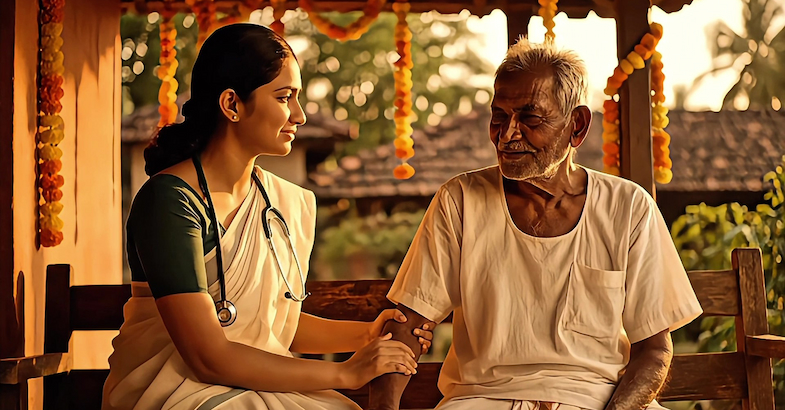
I first met Kishore on a sweltering July afternoon during a field visit, sitting quietly on a worn-down bench in Ludhiana’s civil hospital compound. His sweat-soaked cotton kurta clung to his frail frame; the fabric thinned from years of use. He was still catching his breath, coughing lightly. He had travelled 15 kilometres by local transport and walked the last stretch to see a specialist. The immediate draw was a free meal.
At 86, battling pulmonary tuberculosis (TB), his most urgent concern was not treatment. Even when it strained his limited means and ailing body, he chose to seek care. The pressing challenge was food. “Everything else is secondary. My meals are not sorted, and I cannot come this far to eat every day,” he told me calmly. A migrant labourer from Haryana with no family, spouse, or children, Kishore had once been embraced by a family who he was employed with, until the vicissitudes of life rearranged priorities. “Someone used to help initially. But I cannot expect neighbours to feed me every day,” he said. No resentment, just a quiet acceptance of the circumstances that made others move away.
When I met him in July last year, he had just begun his treatment. In the early stages, when the drugs were harder on his body, sustaining work, doing chores, and securing meals was especially tough. He largely depended on chance kindness. Now, the struggle persists differently as long-term TB treatment, age-related visual and hearing impairment, and the absence of caregivers mean daily sustenance is a challenge.
Kishore’s situation is not an isolated one. In India, roughly 78 percent of older adults survive without a pension, and many remain outside social protection.1,2 Even where programmes exist to provide financial and nutritional assistance to both the elderly and TB patients, the benefits are often too little, delayed, or difficult to access.3,4 For migrant labourers, the challenge is even greater, as systems designed for settled populations are harder for them to navigate. This leaves elderly migrants particularly vulnerable, with weak and unreliable support systems.5
The key gap in cases like Kishore’s is not just about delayed funds or whether treatment is followed. It is also about the absence of support in everyday living: in tasks such as cooking, buying groceries, or managing basic chores. Cash transfers like Nikshay Poshan Yojana assume a level of functional ability that many elderly patients living alone may not have.
This made me rethink possibilities for care delivery. Community-based home care models for elderly TB patients, where local volunteers, ASHA workers, or community groups support with meals and basic tasks, can help bridge care gaps. Alternatively, existing schemes like the midday meal programme offer an operational blueprint. Similar decentralised mechanisms could be adapted to deliver meals to patients who are unable to cook or procure food. Internationally, co-living models, such as those in the Netherlands where students live alongside elderly residents in exchange for companionship and basic support, point to innovative ways of embedding care within communities.
These ideas become even more relevant as India’s population ages and more people find themselves in situations like Kishore’s. They are especially relevant in states like Punjab, where migration of younger family members leaves many older adults without everyday care and support. Unless the system accounts for these unique vulnerabilities of the rising elderly population, the disease burden will tend to fall disproportionately on them.
After seeing the doctor and collecting his food packet that day, Kishore left. I flagged his case as high-risk, but I was left with the image of a man for whom the certainty of his next meal matters more than the promise of treatment. As researchers, we are trained to be methodical, to assign causes cleanly and to eventually close tabs. However, his suffering resisted neat explanations. Is it the healthcare system that assumes family care? Is it the community, built on shared responsibility, that steps back when it matters the most? Or is it the policies, built for blanket profiles instead of real patients? Perhaps it is all of them. I can arrive at no clear conclusion and, for now, the tab remains open.
*The views expressed in this article are solely the personal opinions and reflections of the author(s) and do not necessarily reflect the objectives of the study they are part of. All names of individuals have been changed to protect confidentiality.
References:
- Gopal, K. M., Mukherjee, R., Kumar, S., Hazra, S., Sinha, A., Joshi, D., & Sikka, H. (2024). Senior care reforms in India: Reimagining the senior care paradigm [Position paper]. NITI Aayog. https://www.niti.gov.in/sites/default/files/2024-02/Senior%20Care%20Reforms%20in%20India%20FINAL%20FOR%20WEBSITE_compressed.pdf
- Paul, E., & Sulaiman, K. M. (2025). Understanding Food Insecurity among the Older Adults in India: Insights from the Longitudinal Ageing Study in India–Wave 1 (2017-19). Social Science Spectrum, 9(4), 9-19.
- Arjun, B., Chaitra, C. M., & Ananthakrishnan, M. (2025). Strategic Leverage Points in Implementing India’s Nikshay Poshan Yojana for Tuberculosis Patients: A Scoping Review. Cureus, 17(10).
- Bhattacharya, D & Madan, V (2020, September 11). Flaws in nutritional scheme for TB patients show challenges in feeding the hungry in Covid-19 times. Scroll.in. https://scroll.in/article/972054/flaws-in-nutritional-scheme-for-tb-patients-show-challenges-in-feeding-the-hungry-in-covid-19-times
- Kazi‐Aoul, S., van Panhuys, C., Brener, M., & Ruggia‐Frick, R. (2023). Extending coverage to migrant workers to advance universal social protection. International Social Security Review, 76(4), 111-136.
Author’s Bio:
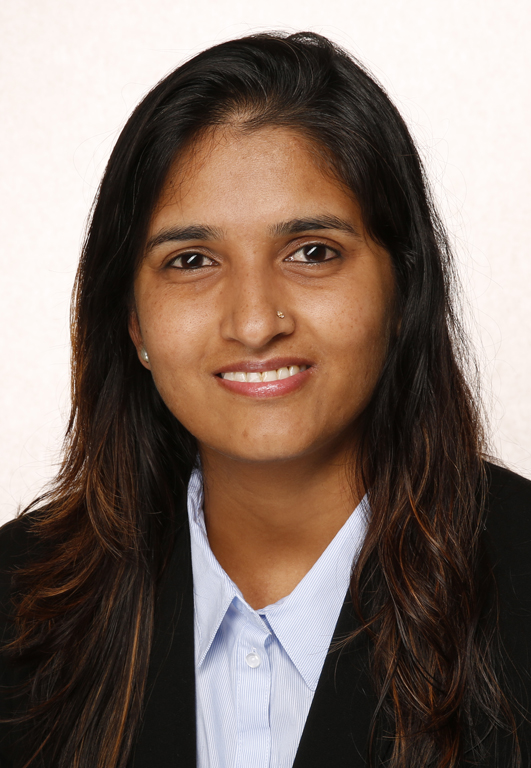
Deepali Verma
Research Analyst at the Max Institute of Healthcare Management, Indian School of Business
Deepali is a Research Analyst at the Max Institute of Healthcare Management, Indian School of Business. She is a biological anthropologist with over a decade of experience in community-based public health, spanning early childhood development, non-communicable disease, antimicrobial stewardship, and digital health. She particularly focuses on applying mixed-method approaches to design and implement interventions that strengthen the health system and improve outcomes. Currently, she is a qualitative researcher in a randomized control trial evaluating digital adherence technologies to improve patient monitoring and treatment outcomes.