

Introduction
Geographical Indication (GI) tagging is a legal designation that connects a product’s specific geographic origin to the unique characteristics, reputation or quality of the product. A GI tag creates a new intellectual property which may turn traditional artisanal craftsmanship into high value brands in the international market, and this may create opportunities to boost the rural economy.
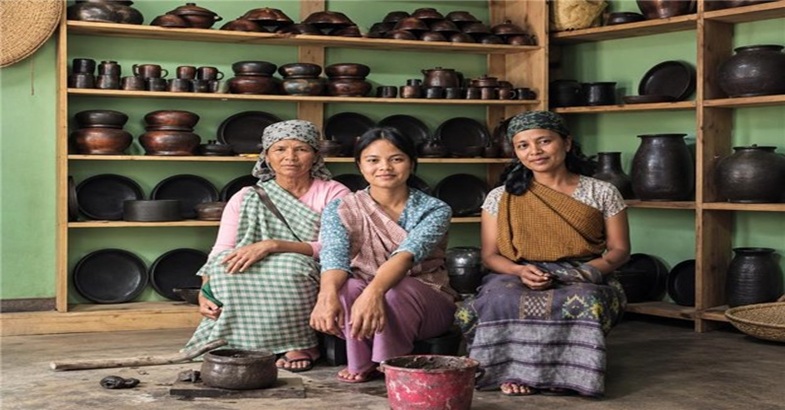
The recognition of Meghalaya’s West Jaintia Hills’ iconic black clay pottery as a GI is a notable recognition of the cultural heritage for the state. Kchu Larnai, a unique black pottery from the villages of Larnai and Tyrshang, is practiced by women folk mainly.
Despite this national recognition, the socio-economic reality on the ground remains precarious. West Jaintia Hills’ formal enterprise base remains thin: only 282 Udyam-registered manufacturing units employed 1,042 people as of 2024-25. Available accounts describe workspaces without electricity, which halts production after sundown, and a raw-material supply that is entirely dependent on seasonal weather. Another study similarly finds that most potter households operate largely outside formal credit and market systems, leaving them dependent on erratic, low-margin sales through intermediaries. A GI tag, by design, only secures legal recognition of a product’s regional origin; it does not by itself resolve these upstream production constraints or reshape the downstream market channels through which the economic value of the craft is captured.
The fundamental issue for the artisans of Larnai-Tyrshang is the narrow social-economic effect of the designation of the product. Significant initiatives are needed to make this craft a livelihood ecosystem to alleviate poverty and create jobs. This blog presents strategic interventions those may be considered to bridge the gap between the GI recognition and the upliftment of the artisanal communities of West Jaintia Hills.
GI tagging on artisan livelihoods
The GI tag is one of the pillars of intellectual property rights (IPR). A GI tag gives additional value to products that are unique to the region. India now has over 800 registered GI products as of 2026.
In many artisanal clusters in India, the earnings gained by the primary producers is very limited and the intermediaries get most of the economic surplus. Some traditional weavers, in well-known clusters, still struggle to escape from chronic poverty and malnutrition. GI tag may be able to serve sustainable prosperity and make villages value adding productive units.
The Khurja Pottery Cluster in Bulandshahr, Uttar Pradesh, offers a comparable case: technology modernisation and capacity-building transformed a fragmented cottage industry into a globally competitive ecosystem, delivering stable, non-farm income to historically marginalised communities.
Vietnam’s Bat Trang village shows a similar rural, handicraft-led trajectory: backed by the One Commune One Product programme, it moved from an agriculture-dependent settlement into an integrated industrial cluster with high-efficiency kilns and a tourism-linked ceramic museum, and its ceramics are now a significant national export.
Strengthening the input side system
Heavy manual labour is required to collect black clay and serpentine stone, and the collection is a highly weather-dependent process. This may be addressed by providing a community-managed raw material bank or processing hub in the block, enabling sustainable extraction and year-round supply. The Government of India’s PM Vishwakarma Scheme, which explicitly covers potters among its 18 recognised artisan trades, can co-finance pulverisers, kilns and drying sheds through its toolkit incentive. Building weatherproof kilns and drying sheds may help artisans withstand weather risks.
Many women-led pottery households face difficulties accessing formal credit networks due to the highly collateralised nature of formal credit and lack of credit histories. PM Vishwakarma’s collateral-free enterprise loans and the PM Employment Generation Programme offer complementary, women-inclusive credit routes that could be linked to Larnai’s self-help groups, helping close the credit gap.
Hands-on business skills training may be conducted in collaboration with government schemes. NABARD’s Micro and Livelihood Enterprise Development Programmes, already active in the district for piggery and poultry, could be extended to pottery-specific modules covering inventory management, fair-trade pricing and digital bookkeeping.
Reshaping marketing
Producers are commonly left out of intellectual property frameworks due to complex registration procedures. A local GI facilitation desk, combined with standardisation and quality control, may simplify this. The Ministry of Textiles’ National Handicrafts Development Programme and Comprehensive Handicrafts Cluster Development Scheme, implemented through the Office of the Development Commissioner (Handicrafts), fund such marketing, design and GI-registration support. Artisans may then deliver the standards expected by luxury hospitality and urban retail markets.
By promoting a Larnai black pottery brand, a marketing advantage may be established. High-quality, eco-friendly packaging protecting the fragile earthenware, paired with heritage positioning and a Quick Response (QR) code linking to the individual craftswoman, the geology of the Sung Valley and its ceremonial significance, can move the product toward the high-value lifestyle market.
The market horizon may be broadened by connecting village workshops with commercial platforms. Efforts to mainstream pottery into experiential tourism circuits, regular exhibitions and craft fairs, and collaborations with premier design institutes can sustain year-round demand and inspire new product lines.
Developing cluster ecosystem and harmonizing governance
In spite of this recognition, the industry is structurally vulnerable because of a fragmented production model. Seng Kynthei Pyrtuh Pottery Organisation has traditionally looked after this craft. Government institutions such as the Directorate of Commerce and Industries and the Meghalaya Basin Development Authority can extend registration, credit-linkage and cluster-facilitation support to village-level associations, ensuring state support and financial inclusion.
Space, firing area and storage constraints sharply cut production during the monsoon. Meghalaya’s Integrated Basin Development and Livelihood Promotion Programme (IBDLP) runs Enterprise Facilitation Centres for craft clusters elsewhere in the state, may offer a template for upgradation of the Larnai common facility centre (CFC) with community-managed raw material banks, pulverisers, kilns, drying sheds and a quality-control unit.
Pottery may be explored in synergy with agriculture and tourism: local cooperatives could join the Lakadong turmeric value chain for GI-branded storage vessels, and link to tourism circuits offering hands-on workshops and culinary experiences.
Without coordination across administrative verticals and levels, isolated action on production, credit, design and marketing wastes state resources. A single coordinating platform, identifying budget gaps and duplication, can connect input-side production improvements with output-side marketing. The District Export Promotion Plan may offer an initial platform for such discussions.
Communicating GI tagging
One important area for intervention noticed during interactions with local stakeholders was the awareness related to GI tags and its potential implications. Communicating GI tags to the grassroots levels may be considered as the first step of all the strategies discussed till now in the blog. Below are few suggestions which may be thought of for the purpose.
Community-based outreach involving participatory meetings and demonstrations can build shared pride and engagement in the registration process.
Local artisan champions, trained on legal rights, pricing and counterfeit protection, can build a self-sustaining, community-led enforcement network.
Community radio broadcasts in Pnar and low-cost mobile alerts can diffuse real-time market data to isolated artisans, while physical information pamphlets in community halls can be a bridge for older potters.
A single-window information system that weaves GI awareness into existing government outreach, for instance linking pottery training to skill-development missions such as Pradhan Mantri Kaushal Vikas Yojana (PMKVY) or to eco-tourism efforts, can widen reach.
These strategies can position GI-certified Larnai pottery as a genuine driver of rural prosperity (Figure 1), turning cultural preservation into an engine for sustainable, generational livelihoods in West Jaintia Hills, Meghalaya.
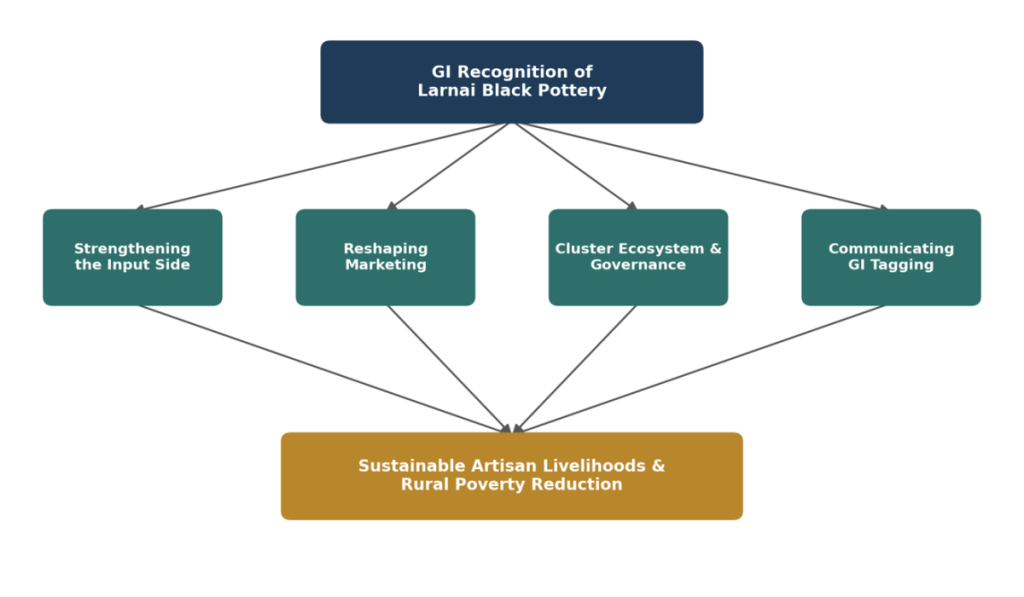
Source: Author’s construction

Author’s Bio: Dr. Badsha Sarkar is working as a Senior Research Fellow under the Meghalaya District Research Fellowship, at the Bharti Institute of Public Policy, Indian School of Business (ISB), Mohali in collaboration with the Planning Department, Government of Meghalaya. Previously, he served as an independent consultant (Economics) at the Indian Institute of Foreign Trade (IIFT), Ministry of Commerce and Industry, Government of India. He holds a PhD in Policy Studies from TERI School of Advanced Studies, New Delhi.